Server memory prices don't usually make headlines. For most of the industry's history, DRAM has been a commodity — abundant, predictable, and largely invisible to everyone except procurement and sales teams. That changed in late 2025.
The Great DDR5 Price Surge - How Demand Outpaced Supply Sending Server Memory Costs Through The Roof
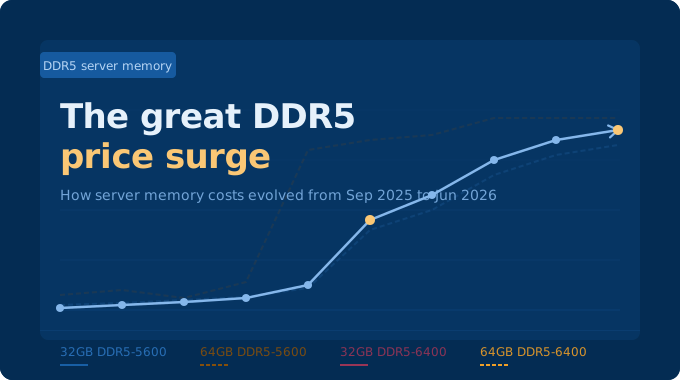
Over the course of just nine months, the price of DDR5 server memory climbed by anywhere from 4x to 9x depending on the module, hitting a wall of scarcity that caught data center operators, cloud providers, and enterprise IT departments largely off guard.
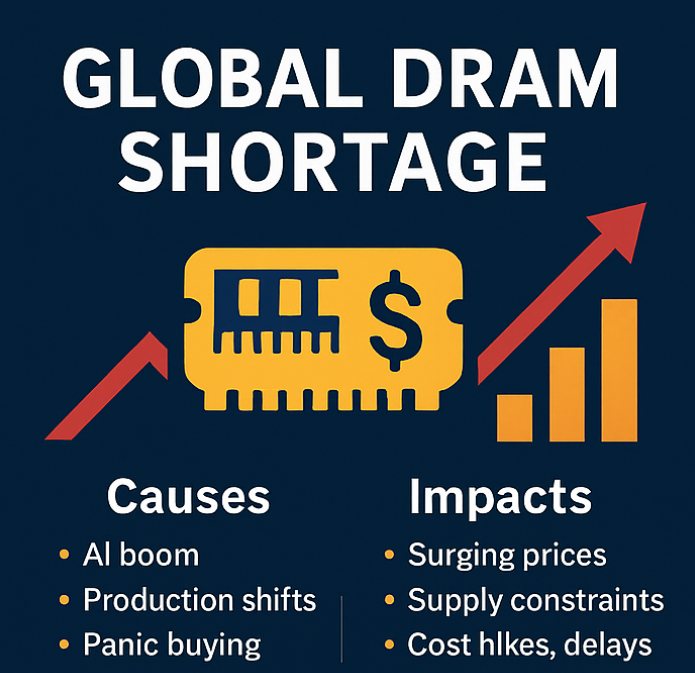
So what happened? The short answer is that demand exploded while supply stood still. Hyperscalers with unlimited budgets purchased a majority of the global supply leaving the rest of the IT industry high and dry.
The single biggest driver of the DDR5 price surge is the insatiable appetite of artificial intelligence infrastructure. Training and serving large language models (LLMs) requires enormous amounts of fast, high-bandwidth memory. A single modern AI accelerator (GPU) can demand hundreds of gigabytes of system memory just to operate efficiently, and hyperscalers have been standing up tens of thousands of these systems at a time.
What changed in late 2025 was the pace. As enterprise AI deployments moved from pilot programs to full production rollouts, demand for high-capacity server memory — particularly 64GB modules at faster speeds — went from strong to frantic. The 64GB DDR5-5600 RDIMM, for example, started September 2025 at $499. By January 2026 it had reached $3,199. By April it plateaued at $3,699, where it has remained. That is not a market behaving normally. That is a market in shock.
What This Means For Everyday Enterprise Buyers
For organizations that have not locked in supply through long-term agreements with OEMs or distributors, the current market is genuinely painful. Budgets built on 2024 memory pricing assumptions are now badly out of date. A server refresh planned at $8,000 per node might now cost $15,000 or more once memory is factored in.
The pricing plateau visible in the data since April 2026 offers some reason for cautious optimism. When prices stop rising and hold flat for multiple months, it often signals that the most acute phase of the shortage is easing — buyers and sellers are reaching an equilibrium, even if it is a painful one. Whether prices will meaningfully retreat depends on whether new manufacturing capacity comes online faster than demand continues to grow.
Given the trajectory of AI infrastructure spending, there is little reason to expect demand to soften. The more likely scenario is that supply gradually catches up over the next 12 to 18 months as manufacturers bring additional DDR5 capacity online and yields improve. Until then, procurement teams would do well to treat server memory not as a commodity to be sourced at the last minute, but as a strategic resource that requires planning, relationships, and lead time.
The era of cheap, plentiful DRAM may not be over permanently — but for now, it is firmly on pause.